


The ECCS Program builds comprehensive statewide systems of care for young children and their families. It helps families connect to the resources they need, even before their babies are born.
Why ECCS matters
The earliest years—from pregnancy through early childhood—shape lifelong health and development. Yet during this critical period, families often must navigate multiple, disconnected services to get the care and support they need.
ECCS helps states build connected, family-centered systems that improve access to high-quality care for families with young children by identifying needs early and linking children and caregivers to services like health care, mental health support, parenting resources, and resources for meeting basic needs such as food and housing.
How ECCS awardees have strengthened systems
Since 2002, ECCS has helped states improve how services are delivered for young children and their families:
Systems integration
- Expanded coordinated intake and referral systems that give families an easy single-entry point to assess their health needs and efficiently connect them to services
- Improved data sharing to track access, identify gaps, and guide decisions
- Advanced state-to-local coordination to improve how systems work together across communities
Workforce support
- Strengthened skills and knowledge in early childhood development across professionals that serve families
Whole-family approach
- Ensured that services and programs support the whole family, addressing the needs of both children and their caregivers across health care, child development, family services, and economic supports.
- Elevated family voice in shaping policies and programs so decisions better reflect family needs and experiences.
Program impact
(Key outcomes from ECCS Health Integration Prenatal-to-Three (HIP-3) investment for Fiscal Year 2025)
ECCS investments have helped states build the partnerships, infrastructure, and family engagement needed to support stronger early childhood systems.
| 1,200+ families Actively involved in ECCS program design so statewide systems better reflect and respond to family needs |
20 out of 20 states Developed strategic plans to advance health and well-being for families from pregnancy through age three |
| 1,000+ partners Participated across health, early learning, and human services in strategic planning and service delivery improvement efforts |
What this means for families:
- Easier access to care through better coordinated systems
- Stronger family voice in shaping policies and programs
- Earlier support for developmental and health needs of children
- Faster connections to services through shared systems and data
ECCS: Scaling Effective Early Childhood Systems Development (ECCS SEED)
The Early Childhood Comprehensive Systems SEED Project: Scaling Effective Early Childhood Systems Development (ECCS SEED) advances the U.S. Department of Health and Human Services’ Make America Healthy Again (MAHA) priorities and represents the next phase of the ECCS program. Building on prior statewide work, ECCS SEED embeds evidence-based programs in high-need and rural communities and learns from those experiences to expand what works statewide. ECCS SEED will create access to coordinated care and services for families and improve health and developmental outcomes for young children.
ECCS SEED supports states and communities to:
- Create a clear entry point for families. Establish or expand Centralized Intake and Referral Systems (CIRS) that assess family needs and connect children and caregivers to appropriate health and human services.
- Improve health and developmental outcomes in high-need communities. Implement community-wide, evidence-based early childhood models that improve well-child visits, developmental screening, parent-child relationships, and child flourishing.
- Learn what works and expand successful approaches. Use lessons from participating communities to strengthen implementation and bring effective approaches to more communities.
- Build infrastructure for statewide expansion and sustainability. Strengthen family leadership, data alignment, statewide coordination, and other systems needed to sustain and expand successful approaches.
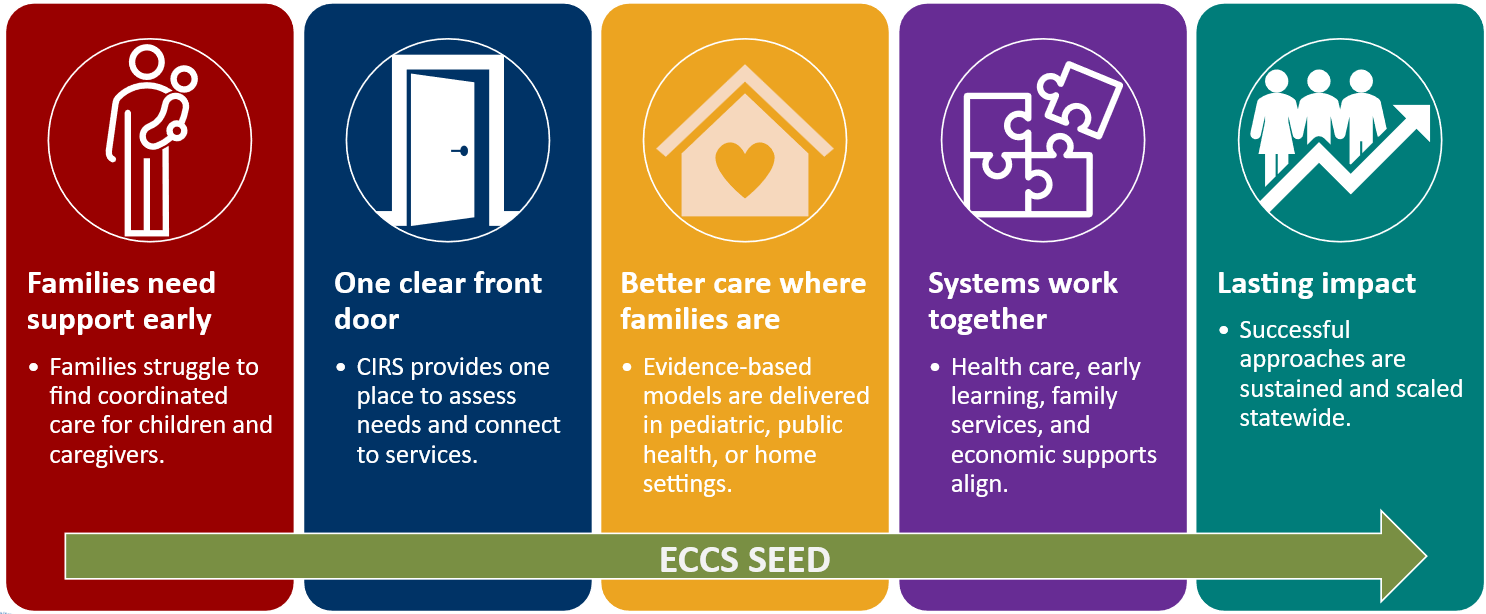
Image description
- Families need support early: Families struggle to find coordinated care for children and caregivers.
- One clear front door: CIRS provides one place to assess needs and connect to services.
- Better care where families are: Evidence-based models are delivered in pediatric, public health, or home settings.
- Systems work together: Health care, early learning, family services, and economic supports align.
- Lasting impact: Successful approaches are sustained and scaled statewide.
Launched in Fiscal Year 2026, ECCS SEED supports eight states to advance ECCS goals. In Fiscal Year 2026, HRSA awarded approximately $7 million (up to $875,000 each).
| Awardee | City | State |
|---|---|---|
| ARHealth Ventures, Inc. | Little Rock | AR |
| Hawaii Department of Health | Honolulu | HI |
| Idaho Association for the Education of Young Children, Inc. | Boise | ID |
| Kansas Department of Health and Environment | Topeka | KS |
| City of New Orleans Health Department | New Orleans | LA |
| Massachusetts Department of Public Health | Boston | MA |
| The Children's Cabinet, Inc. | Reno | NV |
| Vermont Agency of Human Services | Waterbury | VT |
Previous investment: ECCS: Health Integration Prenatal-to-Three
The ECCS: Health Integration Prenatal-to-Three (ECCS HIP-3) Program supported 20 state-level entities and concluded in FY26. This investment helped states strengthen the infrastructure, partnerships, family engagement, and strategic planning needed to support more coordinated systems for families from pregnancy through age three. The lessons, partnerships, and systems developed through HIP-3 provide a foundation for the next phase of ECCS work through ECCS SEED.